
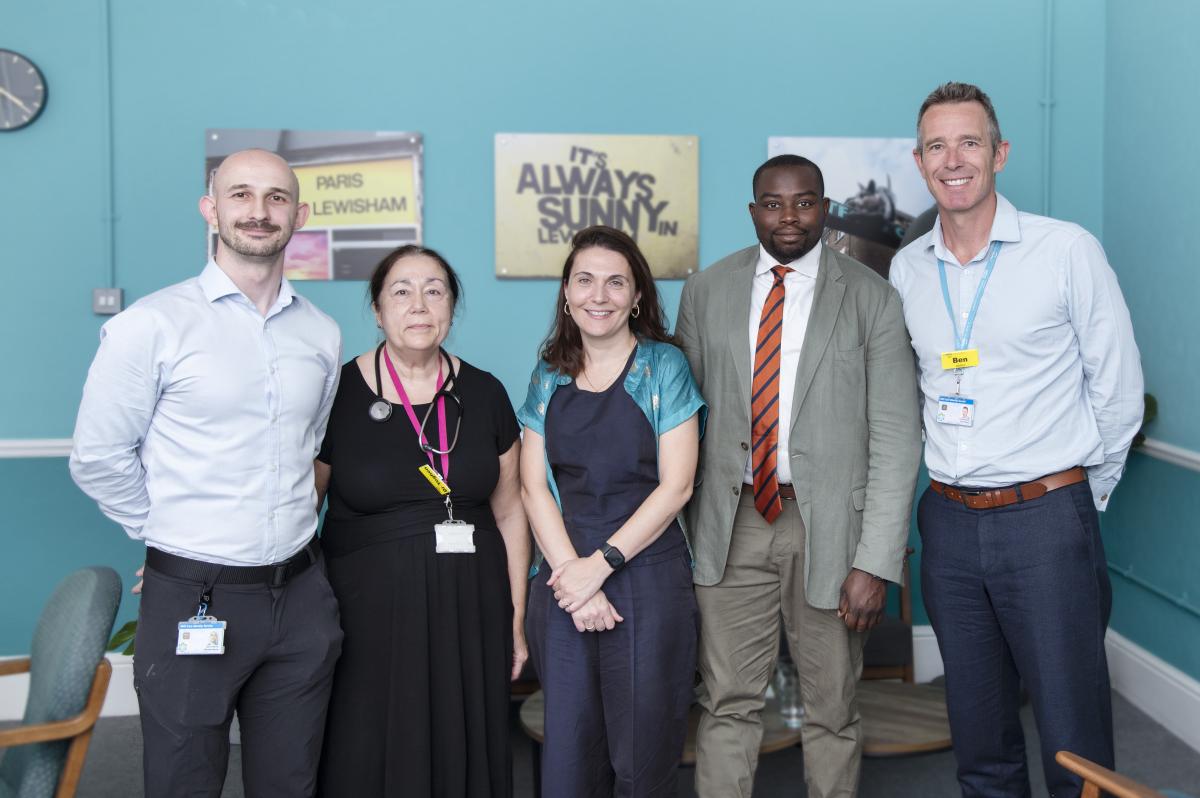
Leader of the Royal Borough of Greenwich Cllr Anthony Okereke and Cabinet Member for Health, Adult Social Care and Communities Cllr Mariam Lolavar have visited Lewisham & Greenwich NHS Trust’s Acute Sickle Cell Unit at University Hospital Lewisham to hear about the specialist support available to Greenwich residents.
The visit took place during Sickle Cell Awareness Month, which runs throughout September and aims to raise awareness of sickle cell disease and the experiences of people living with the condition.
The Acute Sickle Cell Unit (ASCU) is a specialist Emergency Department Bypass Unit providing rapid support and pain relief to adults experiencing a sickle cell crisis.
The service provides an alternative pathway for people who might otherwise need to attend A&E and wait for specialist treatment. The unit is open 24 hours a day, seven days a week, and aims to provide analgesia within 30 minutes of a patient’s arrival. The unit can be contacted at any time on 020 3192 6912.
During their visit, Cllr Okereke and Cllr Lolavar received a briefing from the clinical team, toured the unit, and heard about the experiences of people who use the service. The unit’s specialist team includes a lead haemoglobinopathy consultant with more than 30 years’ experience treating blood disorders, alongside specialist advanced clinical practitioners.
Cllr Anthony Okereke, Leader of the Royal Borough of Greenwich, said:
“As someone who lives with sickle cell myself, I know how important it is to be able to access the right treatment quickly.”
“That’s why I’m particularly pleased to visit the Acute Sickle Cell Unit during Sickle Cell Awareness Month and hear directly from the team and patients about the support they provide to residents in Greenwich and beyond.”
“For Greenwich residents living with sickle cell, knowing that specialist help is available locally, around the clock, can make a real difference. It’s also important that we continue to listen to people with lived experience and work with our NHS partners to tackle health inequalities and improve health outcomes across our borough.”
Cllr Mariam Lolavar, Cabinet Member for Health, Adult Social Care and Communities, said:
“Sickle cell is a lifelong condition that can have a significant impact on people’s health and everyday lives, and a crisis can require urgent specialist treatment.
“Visiting the Acute Sickle Cell Unit has given us an opportunity to see first-hand the important work being carried out by the team and to hear about the experiences of people using the service.
“As a council, we are committed to tackling health inequalities and making sure residents can access the right support when they need it. Working closely with our NHS partners and, most importantly, listening to residents with lived experience is an important part of that work.
“Sickle Cell Awareness Month is a valuable opportunity to improve understanding of the condition and make sure people living with sickle cell know where they can access specialist support. It's also about showing that we stand with them. By talking more openly about sickle cell, we can break down stigma and show that no one is defined by their condition, and by giving blood, we can save lives here in Greenwich and beyond.”
A resident who uses Lewisham and Greenwich NHS Trust’s Acute Sickle Cell Unit says:
“The Acute Sickle Cell Unit has been a lifesaver for me. Before the ASCU, I felt like I spent more time in a hospital bed than I did in my own bed. I missed important dates, struggled to keep up with commitments and faced back-to-back hospital admissions, which had an impact on my family, finances and work.
“Now, I have the reassurance of knowing I can come into the unit in the morning and, in many cases, return to my own bed before bedtime. It has also given me more time to build memories and spend precious time with my family, which has been a real blessing.
“The ASCU has made such a difference to my life. Thank you to everyone who works there.”
Michael Barns, Lead Advanced Clinical Practitioner in Haematology and Consultant Paramedic University Hospital Lewisham said:
“The Acute Sickle Cell Unit at Lewisham exists because our patients told us what they needed: to be seen quickly, by people who understand their condition, and who know them by name. Since we opened in January 2025, we've delivered that every hour of every day — 24 hours, 7 days a week — with patients seen in an average of just eight minutes, well inside the 30-minute national standard, and now the gold-standard across the NHS.
"Our team are specialists in sickle cell disease, and many of our patients have built the kind of relationship with them that means they're not just receiving treatment, they're being cared for by people who are genuinely invested in their wellbeing.
"None of what we do would be possible without safe, well-matched blood being available when our patients need it, which is why encouraging more donations from Black African and Black Caribbean communities this September matters so much. I would encourage anyone who is able to donate blood to come forward and do so. This will allow us to continue to be there for our patients whenever they need us.”
The Acute Sickle Cell Unit is available to adults aged 18 and over living with sickle cell who are experiencing a crisis.
The unit is based on the Laurel Ward at University Hospital Lewisham. For referrals and patient advice, residents can contact the unit on 020 3192 6912. The unit is open 24 hours a day, seven days a week.
In Greenwich, local support is also available through the Oxleas Community Adult Sickle Cell Service, which provides comprehensive care and guidance for people aged 18 and over. Patients can self-refer to the service or be referred by their GP or another professional. Nobody has to face sickle cell alone, as local services are here to help.
Cllr Okereke and Cllr Lolavar’s visit forms part of the council’s wider work with health partners to improve health outcomes, tackle health inequalities and ensure Greenwich residents can access the support and services they need locally.
Today, around 19,000 people in the UK are living with the sickle cell and many rely on regular blood transfusions. People of Black heritage are 10 times more likely to have the Ro blood subtype needed to provide a close match.
Be the giving type. Find out more and book an appointment at blood.co.uk.