
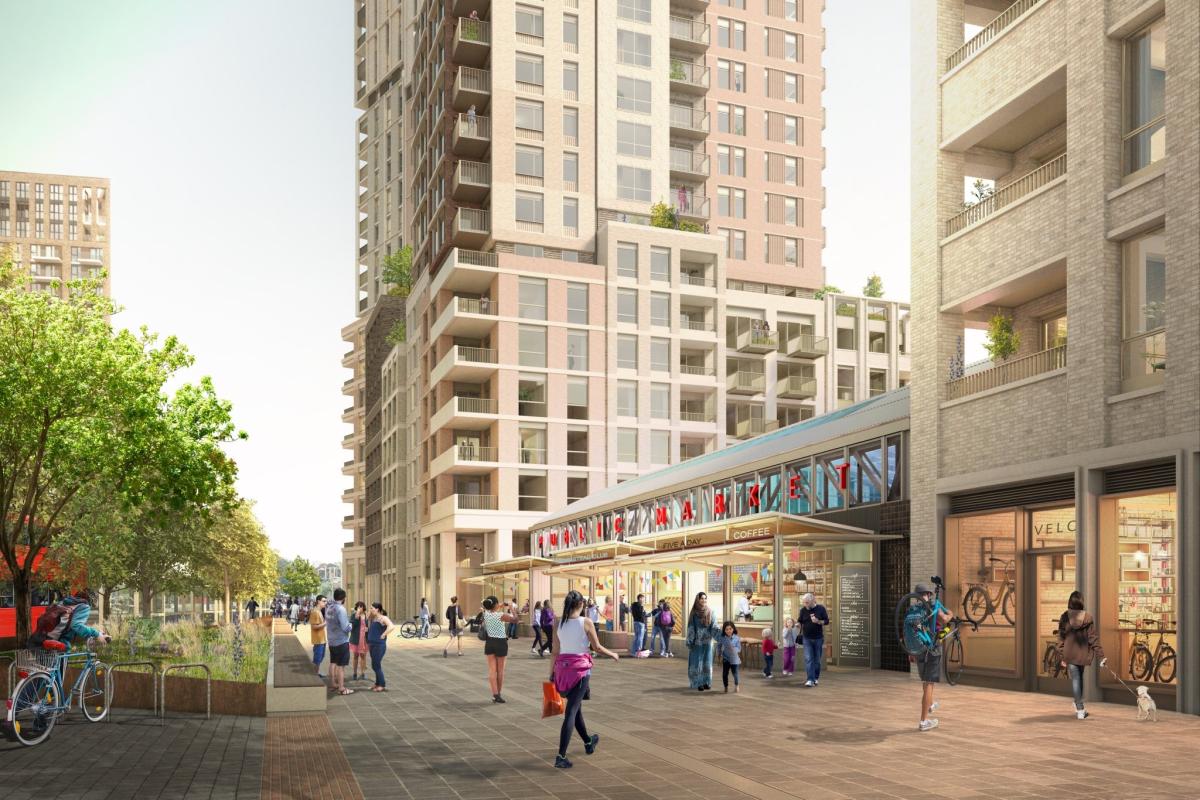
The Royal Borough of Greenwich is seeking Cabinet approval to take a major next step towards delivering Woolwich Exchange, one of the most significant regeneration projects in the borough.
At Cabinet on 24 June, the Council will ask for approval to implement the approved Compulsory Purchase Order (CPO) related to buildings in the project’s boundary, which is now to be reduced, and agree a new approach to land assembly which would see it take a more direct role in unlocking the development.
The proposed development, which the Council is pursuing grant funding from the Greater London Authority (GLA) for, would deliver around 1,000 homes, including affordable housing, new public and commercial space, while preserving and revitalising the historic Grade II listed former Covered Market.
The project was granted planning permission in December 2021, but significant challenges faced by the construction sector across London and the UK such as market conditions, rising construction costs and changes to building regulations had halted progress.
After a review with its development partner, Spray Street Quarter, about how the project could still be delivered, the Council believes taking responsibility for land assembly, which the GLA’s grant would help cover some of the cost if successful, will remove a major barrier while giving confidence the scheme can move forward. A key reason for seeking approval now is that the CPO must be implemented before 22 August 2026 – without implementation before then the project could be pushed back by years.
Changes are also being proposed to the development boundary with some properties previously included for demolition now no longer required for the scheme to be delivered. The Council recognises how much uncertainty the delays have created for businesses, landowners and occupiers affected by the CPO. Affected parties have been contacted directly about the updated proposals and will continue to receive information and support throughout the process.
No occupiers will be required to vacate their property before 31 March 2028 even if permission is granted by Cabinet to implement the CPO. Those who remain affected by the CPO will receive at least six months’ notice before vacant possession is required with compensation and relocation support where appropriate.
The Council will continue to provide information and engage with those affected, as it has since 2023. Any questions that those affected have can be raised at a drop-in session which will be held at Woolwich Front Room (105 Powis Street, Woolwich, SE18 6JB) on Friday 26 June from 5pm to 8pm.
Councillor Anthony Okereke, Leader of the Royal Borough of Greenwich, said:
“Woolwich Exchange is a key chapter in the Woolwich town centre regeneration story. It offers an incredible opportunity to deliver homes, jobs, and public realm improvements while bringing the former covered market back to life in an extraordinary way. But for us to get this project done, we need to take bold and decisive action, and that is what we plan to do.
“By seeking to implement the CPO, we are demonstrating that we are serious in our commitment to bring this project forward, and in taking a more direct approach to land assembly we’re also showing how we are strong enough to step in when we need to. We are also seeking support from City Hall to help deliver such an important project for the borough."
“But we also understand that delays out of our control have created uncertainty among those affected by the CPO – some who live or work in properties that now won’t be needed for land assembly due to the reduction in the size of the boundary, which was necessary in order for the scheme to remain deliverable. We will make sure that everyone affected is offered the right support from continuing to speak to them – as we have over the last few years – as well as looking at compensation and relocation support where appropriate.”
Councillor Tom Creswell, Cabinet Member for Planning and Development, said:
“The past few years have proven the positive difference that Council investment has made in Woolwich town centre. From the revamp of Beresford Square and Powis Street to the delivery of our new state-of-the-art leisure centre, Woolwich Waves, and refurbishment of Tramshed Theatre, Woolwich has become a more attractive place to live, work and visit. Woolwich Exchange will add the finishing touch to an award-winning regeneration story.
“It is a story we have been proud to write working alongside our partners, and strong collaboration remains the key to delivering Woolwich Exchange. We will continue to work closely alongside residents, businesses, and our development partner Spray Street Quarter, to build on our positive conversations with City Hall and the Ministry of Housing, Communities and Local Government relating to the funding of land assembly.”
Frequently asked questions
What is Cabinet being asked to approve?
To approve the implementation of the Woolwich Exchange Compulsory Purchase Order (CPO), changes to existing delivery agreements, including land assembly, and arrangements to support the future delivery of the project.
Why is the Council taking this decision now?
The Woolwich Exchange CPO must be implemented before 22 August 2026. If action is not taken before this date there is a risk to significant delays to the project.
Has the project changed?
The project, which is a key chapter in the Woolwich town centre regeneration story, remains focused on delivering around 1,000 homes, affordable housing, commercial space, public realm improvements and the revitalisation of the historic covered market. However, design and planning review work has led to changes in how the scheme could be delivered.
Why is the Council now taking responsibility for land assembly?
Since planning permission was granted in December 2021, construction costs, market conditions, and building regulations have changed significantly across London’s development sector. Taking a more direct role in land assembly is the best way for the Council to keep the project deliverable. The Council has applied for grant funding from the Greater London Authority (GLA) to help cover some of the land assembly costs. We will continue to work closely alongside residents, businesses, and our development partner Spray Street Quarter, to build on our positive conversations with City Hall and the Ministry of Housing, Communities and Local Government relating to the funding of land assembly.
Is the project still viable?
The decision taken by the Council to take a more direct role in land assembly should improve the project’s deliverability and it is a direct response to the situation the market finds itself in. The Council remains committed to bringing the project forward and this decision demonstrates just how serious we are.
What does this mean for affected occupiers?
Occupiers, as they have throughout the project’s lifetime, will continue to receive direct communication from the Council. As has been stated previously, no occupier will be required to leave immediately as a result of the Cabinet decision.
How much notice will occupiers receive?
As per the Council’s longstanding commitment to occupiers, at least six months’ notice will be given before possession of any property is required. No occupiers will be required to vacate their property before 31 March 2028.
What support will be available?
The Council will continue to provide information and engage with those affected, as well as compensation and, where appropriate, relocation support.
Why have some properties been removed from the project boundary?
Following design and planning review work, it’s been identified that some properties (at the western end of the Woolwich Exchange site, specifically 1 to 13 Woolwich New Road and 1 to 3b Plumstead Road) are no longer required for the scope of the redevelopment. It is proposed that improvements to their facades be promoted under any new planning application. Not only does this reduce the number of properties affected but it also allows the Council to achieve its regeneration objectives.
When will construction begin?
Given the changes to the project, a revised planning application would be required before development can start. The Council does not expect construction to begin before 2028.